Combinations (合) in Saju
Published: · Last Updated: · By Sajugazer
What Is a Combination (合) in Saju?
In Saju (Four Pillars of Destiny), a combination (合, hap) refers to the interaction between Heavenly Stems (天干) or Earthly Branches (地支) that harmoniously unite their energies — often transforming or amplifying their original qualities in the process. Where clashes (충) divide and confront, combinations converge and cooperate. Understanding both is essential for reading the dynamic currents of any chart.
Consider a chart whose Earthly Branches are 亥·巳·未·丑 — Water, Fire, and Earth energies, with no Wood or Metal present. When the luck cycle (運) brings in 卯, the Wood energy is not merely "introduced" but amplified through combination. When 酉 enters instead, Metal energy intensifies. For a chart that lacks Expression Stars (食傷), this amplification marks a period when that behavioral tendency becomes pronounced. For one that urgently needs Metal, the arrival of 酉 can create exceptionally favorable conditions.
Similarly, a chart with Heavenly Stems 戊·癸·壬·甲 and no Fire in sight will respond very differently when a luck cycle brings Earthly Branches of 巳·午·未. Fire does not merely "arrive" — it enters with accumulated force, driven by the combining logic already present in the chart. This is the essence of why combinations matter.
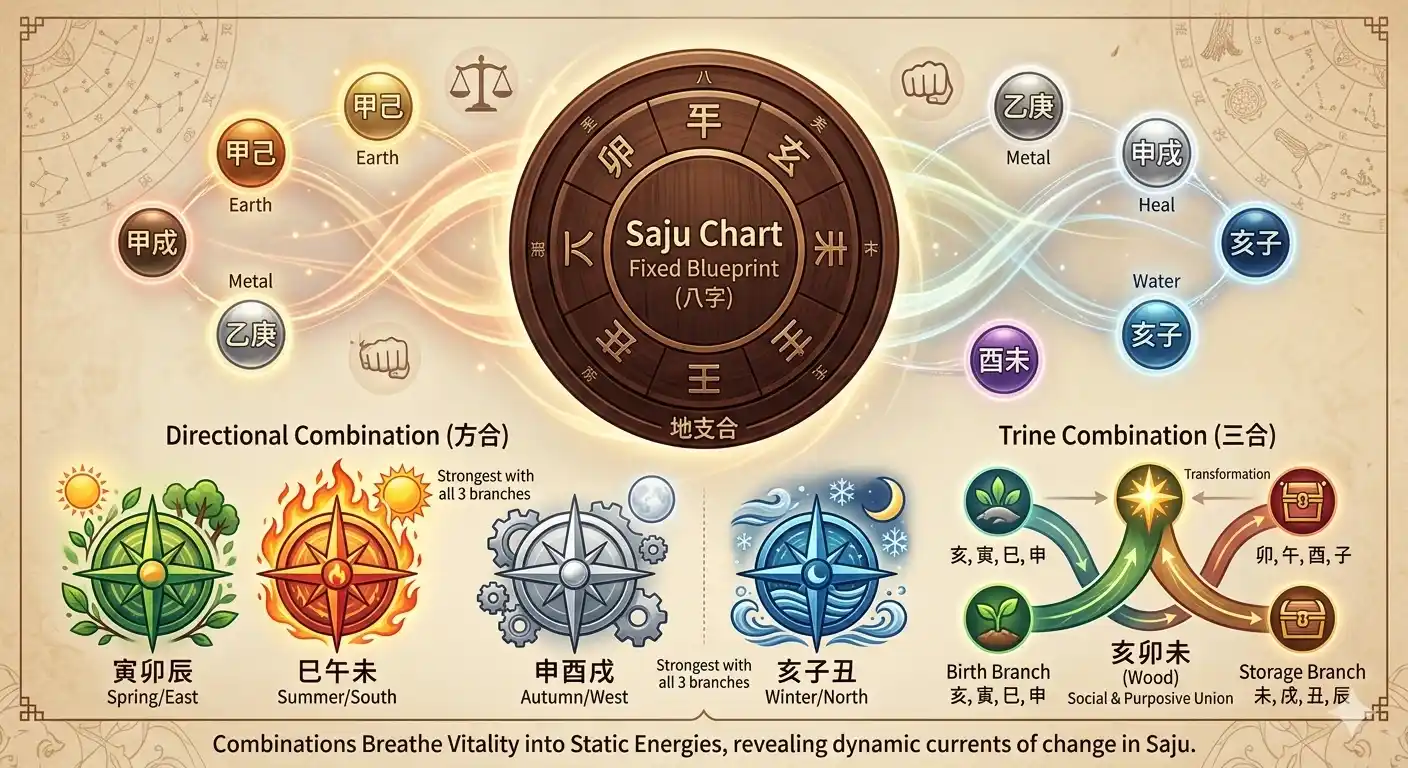
Classification of Combinations
Combinations in Saju are divided into two major categories: Heavenly Stem Combinations (天干合) and Earthly Branch Combinations (地支合). The Earthly Branch Combinations are further split into two distinct types based on their structural logic.
| Type | Category | Pairs / Groups | Result |
|---|---|---|---|
| Heavenly Stem (天干合) | — | 甲己, 乙庚, 丙辛, 丁壬, 戊癸 | Elemental transformation |
| Directional (方合) | Earthly Branch | 寅卯辰, 巳午未, 申酉戌, 亥子丑 | Elemental amplification |
| Trine (三合) | Earthly Branch | 亥卯未, 寅午戌, 巳酉丑, 申子辰 | Elemental transformation |
Each type operates through a different structural logic, and each carries distinct implications for how the chart's energy landscape shifts.
Heavenly Stem Combinations (天干合): When the Energies of Heaven Unite
Structure and Principle
Heavenly Stem Combinations occur when a Yang Stem (陽干) and a Yin Stem (陰干) pair to bond as a new elemental energy. The underlying principle follows the Six Harmonies (六合): each stem combines with the stem that sits six positions away on the circular arrangement of the ten stems. Imagine placing the ten stems — 甲·乙·丙·丁·戊·己·庚·辛·壬·癸 — at equal intervals around a circle; the stems facing each other directly across that circle form a combination pair.
The Five Heavenly Stem Combinations and Their Transformations
There are five such pairings, each producing a distinct elemental transformation:
| Pair | Name | Transforms Into | Traditional Reading |
|---|---|---|---|
| 甲 + 己 | Combination of Righteous Balance (中正之合) | Earth (土) | 甲Wood — origin of all things — takes root in 己Earth, creating Earth as the foundation of life. |
| 乙 + 庚 | Combination of Strength and Flexibility (剛柔之合) | Metal (金) | Supple 乙Wood meets firm 庚Metal and acquires discipline, becoming hard and decisive. |
| 丙 + 辛 | Combination of Authority and Control (威制之合) | Water (水) | Blazing 丙Fire melts cold 辛Metal into liquid — the water that nourishes all things. |
| 丁 + 壬 | Combination of Benevolence and Longevity (仁壽之合) | Wood (木) | Gentle 丁Fire meets vast 壬Water and gestates new life force, channeling the energy of growth. |
| 戊 + 癸 | Combination Without Sentiment (無情之合) | Fire (火) | Mountain 戊Earth meets heavenly 癸Water to form clouds, rain, and ultimately lightning — explosive Fire energy. |
A Balanced Perspective on Heavenly Stem Combinations
Interpretations of Heavenly Stem Combinations vary considerably among scholars, as do opinions on whether they activate in a given chart. Flexible, empirically grounded interpretation is key, and developing one's own clinical framework over time is an essential part of serious Saju study.
One perspective drawn from years of practice holds that 乙庚→Metal, 丙辛→Water, 丁壬→Wood, and 戊癸→Fire combinations tend to activate when luck cycles corresponding to the resulting element arrive — specifically, 申酉戌 for Metal, 亥子丑 for Water, 寅卯辰 for Wood, and 巳午未 for Fire. This framework can be useful for interpreting behavioral vectors and relationship patterns. It is a subjective interpretive approach, however, and may differ from other scholars' views or from observed reality in specific charts.
Directional Combination (方合): Seasonal Unity
The Principle of Directional Combination
The Directional Combination (方合) is formed when three Earthly Branches sharing the same cardinal direction and season unite, creating a powerfully cohesive elemental force. The cohesion here resembles the tight bonds of family and blood: these branches were already oriented in the same direction before they combined, and their union is a natural intensification of a shared identity.
| Branches | Direction / Season | Combined Element |
|---|---|---|
| 寅 · 卯 · 辰 | East / Spring | Wood (木) |
| 巳 · 午 · 未 | South / Summer | Fire (火) |
| 申 · 酉 · 戌 | West / Autumn | Metal (金) |
| 亥 · 子 · 丑 | North / Winter | Water (水) |
Key Interpretive Points
The combination is strongest when all three branches are present in the chart. Having only two creates a Half Combination (半合), which still carries the combination's tendency but at reduced strength. When the remaining branch arrives through a luck cycle or a significant relationship, the combined energy intensifies considerably.
Whether that intensification is welcome depends entirely on the chart's elemental balance. If 亥 and 丑 are already in the chart and Water is the favorable element (用神), the chart is in a beneficial state — but when 子 arrives through luck or relationship, the power becomes even more pronounced and favorable. On the other hand, if 午 and 未 are already creating overpowering Fire energy — especially when one occupies the Month Branch — and that intensity is causing adverse effects, the arrival of 巳 through a luck cycle deserves careful attention. In such cases, it is worth consciously managing that amplified force rather than riding it uncritically.
Trine Combination (三合): The Cycle of Birth, Peak, and Storage
Principle and Structure
The Trine Combination (三合) is a purposive union in which three Earthly Branches of different original elements combine to form a single powerful elemental energy. Unlike the Directional Combination, which intensifies a pre-existing element, the Trine brings together branches that are not elemental neighbors — and through that meeting, something new is born.
It unites the Birth Branch (生支), the Peak Branch (旺支), and the Storage Branch (庫支) to enact a three-stage cycle of beginning, flourishing, and completion:
| Trine | Birth Branch | Peak Branch | Storage Branch | Combined Element |
|---|---|---|---|---|
| Wood Trine (木三合) | 亥 (Water) | 卯 (Wood) | 未 (Earth) | Wood (木) |
| Fire Trine (火三合) | 寅 (Wood) | 午 (Fire) | 戌 (Earth) | Fire (火) |
| Metal Trine (金三合) | 巳 (Fire) | 酉 (Metal) | 丑 (Earth) | Metal (金) |
| Water Trine (水三合) | 申 (Metal) | 子 (Water) | 辰 (Earth) | Water (水) |
Understanding Trine Combinations Through Hidden Stems (地藏干)
The logic of the Trine becomes far clearer when viewed through the lens of Hidden Stems (지장간). The Birth Branches — 寅·申·巳·亥 — each harbor the long-life energy (長生) of a new element within their Hidden Stems. 寅, for instance, contains 丙Fire within its hidden stems, planting the seed of the Fire Trine from inside a Wood branch. The Peak Branches — 子·午·卯·酉 — carry the pure peak-energy (帝旺) of their respective elements and serve as the central axis around which the Trine organizes itself. The Storage Branches — 辰·戌·丑·未 — correspond to the Tomb Stage (墓) in the 12 Stages of Energy, where elemental energy reaches its end and is sealed away.
Seen through this structure, the Trine is not an arbitrary grouping but a faithful map of how elemental energy is born, reaches its zenith, and finally comes to rest. The three branches are, in a sense, already inscribed to cooperate.
Trine vs. Directional Combination: A Key Distinction
While Directional Combinations amplify an already-dominant element, Trine Combinations involve an elemental transformation — the Birth and Storage Branches shift toward the element of the Peak Branch. That said, it is more practical and nuanced to read this not as a complete erasure of the original qualities, but as those qualities being weakened while the new elemental qualities are strengthened. A rigid insistence on total transformation tends to produce overly constrained interpretations that do not hold up well in real chart work.
A Practical Example
Consider a chart born in the 酉 Month with 庚Metal as the Day Master, with 寅 and 戌 in the Earthly Branches and no Fire energy elsewhere. This is a strong Yang-type chart (陽刃格) where the self is overly dominant and needs Fire to keep it in check — yet Fire is entirely absent, making it an urgently needed element.
When 午Fire enters through the luck cycle, it is already interpreted as favorable on its own. But when the Trine framework is applied, 寅 and 戌 do not simply stand by: they cooperate with the incoming 午 to complete the 寅午戌 Fire Trine. The result is significantly more powerful and beneficial than the arrival of 午 alone would suggest. This is where Trine analysis moves beyond simple elemental presence and into the real dynamics of chart change.
Final Thoughts: Reading the Vector of Combination
Combinations breathe vitality into the fixed blueprint of the Eight Characters (八字). Within the static arrangement of stems and branches, they generate unexpected currents of change — amplifying deficient energies, transforming existing ones, and creating momentum that static elemental analysis alone cannot reveal.
The key insight is this: a combination does not mean the original character simply vanishes. Saju interpretation is ultimately a search for balance and harmony. When a combination causes a particular element to grow excessively strong, the question is whether that strength will act as medicine or poison. When a deficient energy is replenished through combination, the question becomes what mindset and actions one should adopt when that opportunity arrives. This is the true art of Saju analysis.
Theory should be rigorous, but interpretation must remain flexible. The most important skill is not memorizing combination formulas — it is reading where a given combination moves the vector of a life. Use these foundational principles as a lens to look deeply into a chart. When you can perceive the dynamic currents of change hidden behind each character, Saju transforms from a statistical framework into a living, three-dimensional map.
Continue Reading
← Previous: Useful God (Yongshin) in Saju
Related: how branches oppose and clash:
See It in Action
See how Combinations interact with the rest of a real Saju chart: